STEM Education in U.S. 2025: Opportunities & Challenges
Anúncios
The 2025 landscape of STEM education in the U.S. is defined by both significant opportunities for innovation and student development, alongside persistent challenges related to equitable access, teacher shortages, and the rapid pace of technological change, demanding proactive solutions.
The 2025 Landscape of STEM Education in the U.S.: Opportunities and Challenges for Students is rapidly evolving, demanding a closer look at what lies ahead. As technology continues to reshape our world, the importance of science, technology, engineering, and mathematics (STEM) education has never been more critical for the nation’s future workforce and innovation. This article delves into the dynamic environment that students, educators, and policymakers will navigate in the coming year.
Anúncios
The Accelerating Demand for STEM Professionals
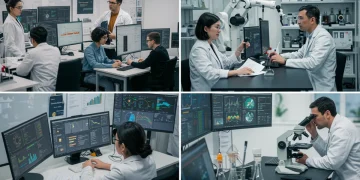
The United States economy is increasingly reliant on a robust STEM workforce. Projections for 2025 indicate a continued surge in demand across various sectors, from artificial intelligence and biotechnology to renewable energy and advanced manufacturing. This escalating need creates significant opportunities for students pursuing STEM fields, promising fulfilling careers and substantial contributions to society.
This demand isn’t just about raw numbers; it’s also about specialized skills. Companies are seeking individuals who can not only solve complex problems but also innovate and adapt to new technologies at a rapid pace. This shift influences curriculum development and pedagogical approaches in educational institutions nationwide.
Anúncios
Emerging STEM Career Pathways
New industries and technological advancements are constantly creating novel job roles that require specific STEM competencies. Understanding these emerging pathways is crucial for guiding students toward future success.
- Artificial Intelligence and Machine Learning: Roles like AI engineers, data scientists, and machine learning specialists are booming, requiring strong computational and analytical skills.
- Biotechnology and Gene Editing: Advances in genomics and personalized medicine are driving demand for bioinformaticians, genetic counselors, and biomedical engineers.
- Cybersecurity: With increasing digital threats, cybersecurity analysts, ethical hackers, and security architects are indispensable across all sectors.
The continuous evolution of these fields means that STEM education must be agile, preparing students not just for current jobs but for those yet to be imagined. This forward-thinking approach is a cornerstone of effective STEM programs.
Technological Integration in STEM Learning
The integration of cutting-edge technology into STEM education is transforming how students learn and interact with complex concepts. By 2025, tools like virtual reality (VR), augmented reality (AR), and advanced simulation software are becoming more commonplace, offering immersive and interactive learning experiences that were once unimaginable. These technologies not only make learning more engaging but also provide practical experience with tools used in professional STEM environments.
Beyond immersive experiences, artificial intelligence is also playing a role in personalizing learning pathways, adapting to individual student needs and providing tailored feedback. This level of customization can significantly enhance comprehension and retention, addressing diverse learning styles within the classroom.
Virtual and Augmented Reality in Classrooms
VR and AR offer unparalleled opportunities for students to explore complex scientific phenomena and engineering principles in a safe, controlled, and interactive environment. Imagine dissecting a virtual frog or designing a bridge in a simulated world without physical constraints.
- Immersive Field Trips: Students can virtually visit distant laboratories, historical sites, or even outer space, bringing contextual learning to life without leaving the classroom.
- Hands-on Simulations: Complex experiments in chemistry, physics, or engineering can be simulated, allowing for repeated practice and exploration of variables without material costs or safety risks.
- Collaborative Design: AR tools enable students to overlay digital models onto the real world, facilitating collaborative design projects and problem-solving in a dynamic setting.
These technological advancements are not merely gadgets; they are powerful pedagogical tools that can bridge the gap between theoretical knowledge and practical application, preparing students for real-world STEM challenges. Educators are increasingly trained to leverage these tools effectively, creating a more dynamic learning landscape.
Addressing the Equity Gap in STEM Education
Despite significant advancements, the equity gap remains a persistent challenge in U.S. STEM education. Access to quality STEM programs, resources, and opportunities often varies significantly based on socioeconomic status, geographic location, and demographic factors. By 2025, efforts to bridge this divide are intensifying, recognizing that a truly innovative workforce must be inclusive and representative of all segments of society.
Initiatives focused on providing underserved communities with better access to technology, qualified teachers, and engaging STEM curricula are crucial. This includes targeted funding, mentorship programs, and partnerships between schools and industry to inspire and support a broader range of students.
One of the most critical aspects of addressing the equity gap is ensuring that all students, regardless of their background, have access to high-quality STEM educators. This often means investing in teacher training and recruitment programs that specifically target diverse candidates and those willing to teach in high-needs areas.
Challenges in Equitable Access
Several factors contribute to the ongoing disparities in STEM education, requiring multifaceted solutions.
- Digital Divide: Unequal access to reliable internet and computing devices disproportionately affects low-income and rural students, hindering their participation in online learning and digital skill development.
- Teacher Shortages: Schools in underserved areas often struggle to attract and retain qualified STEM teachers, leading to less rigorous instruction and fewer advanced course offerings.
- Lack of Role Models: Underrepresented groups may lack visible role models in STEM, which can impact aspirations and perceptions of career feasibility in these fields.
Addressing these challenges requires a concerted effort from policymakers, educators, community leaders, and industry partners to create pathways and support systems that ensure all students can pursue their STEM interests and talents.
The Evolving Role of STEM Educators
The role of STEM educators in 2025 is shifting from traditional instructors to facilitators of discovery and innovation. With the rapid pace of technological change and the increasing complexity of scientific fields, teachers must continuously update their own knowledge and pedagogical approaches. They are tasked with fostering critical thinking, problem-solving skills, and creativity, rather than simply delivering content.
Professional development programs are becoming more vital, equipping educators with the skills to integrate new technologies, implement interdisciplinary approaches, and effectively engage diverse student populations. The emphasis is on creating dynamic learning environments where students actively construct knowledge and develop essential 21st-century competencies.
Key Competencies for 21st-Century STEM Teachers
Effective STEM teaching in 2025 demands a specific set of skills and a commitment to continuous learning.
- Technological Proficiency: Educators must be adept at using and integrating various digital tools, software, and platforms into their teaching practices.
- Interdisciplinary Approach: The ability to connect different STEM disciplines and integrate them with other subjects like arts and humanities is crucial for holistic learning.
- Culturally Responsive Pedagogy: Teachers need to create inclusive learning environments that respect and leverage students’ diverse backgrounds, experiences, and perspectives.
The success of STEM education hinges significantly on the quality and adaptability of its educators. Investing in their ongoing development is an investment in the future of the entire STEM pipeline.
Promoting Interdisciplinary STEM Approaches
The silos between traditional STEM disciplines are increasingly breaking down, giving way to more interdisciplinary approaches. Real-world problems rarely fit neatly into a single academic category; solving them often requires insights and methods from multiple fields. By 2025, STEM education is emphasizing projects and curricula that integrate science, technology, engineering, and mathematics, fostering a more holistic understanding and application of knowledge.
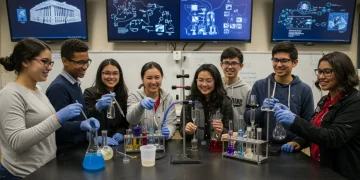
This approach encourages students to think creatively, collaborate effectively, and apply diverse tools to complex challenges. It mirrors the collaborative nature of professional STEM environments, where teams of experts from different backgrounds work together to achieve common goals.
Benefits of Integrated STEM Learning
Adopting an interdisciplinary model offers numerous advantages for student development and future career readiness.
- Enhanced Problem-Solving: Students learn to analyze problems from multiple perspectives, drawing on various disciplines to formulate comprehensive solutions.
- Increased Engagement: Project-based learning that integrates different subjects often proves more engaging and relevant to students, sparking curiosity and deeper learning.
- Career Readiness: This approach better prepares students for the collaborative and complex nature of modern STEM careers, where interdisciplinary skills are highly valued.
The shift towards interdisciplinary STEM is not just a pedagogical trend but a necessary evolution to prepare students for a world where innovation thrives at the intersection of different knowledge domains.
Funding and Policy Initiatives for STEM Growth
Government agencies, private foundations, and industry partners are recognizing the critical importance of robust STEM education. By 2025, there’s a growing emphasis on strategic funding and policy initiatives designed to strengthen the STEM pipeline from early childhood through higher education and into the workforce. These initiatives aim to address existing challenges and capitalize on emerging opportunities.
Policies often focus on increasing access for underrepresented groups, supporting teacher development, and promoting research and innovation in STEM fields. Public-private partnerships are also playing a crucial role in pooling resources and expertise to maximize impact, driving both educational reform and economic growth.
Key Areas of Investment and Policy Focus
Strategic investments are being made in several critical areas to bolster STEM education across the U.S.
- Early Childhood STEM: Programs designed to introduce STEM concepts at young ages, fostering curiosity and foundational skills before formal schooling begins.
- Teacher Recruitment and Retention: Funding for scholarships, professional development, and competitive salaries to attract and keep highly qualified STEM educators.
- Research and Development: Support for educational research into effective STEM pedagogies and the development of innovative curricula and learning tools.
These concerted efforts in funding and policy are essential for creating a sustainable and thriving STEM ecosystem that can meet the demands of the 21st century and beyond.
| Key Aspect | Brief Description |
|---|---|
| Demand for STEM Professionals | Accelerating need for skilled workers in AI, biotech, cybersecurity, and advanced manufacturing. |
| Technological Integration | VR, AR, and AI enhance immersive and personalized learning experiences in STEM classrooms. |
| Equity Challenges | Persistent disparities in access to quality STEM education for underserved communities. |
| Interdisciplinary Approaches | Shift towards integrated STEM curricula to foster holistic problem-solving and collaboration. |
Frequently Asked Questions About STEM Education in 2025
Students in 2025 will benefit from increased demand in emerging fields like AI, biotechnology, and cybersecurity, leading to diverse career paths. Enhanced technological tools such as VR and AR will also offer more immersive and effective learning experiences, preparing them for future innovations and job market demands.
Technology is transforming STEM learning by integrating virtual and augmented reality for immersive simulations and virtual field trips. AI-driven platforms are also personalizing learning paths, adapting content to individual student needs, and providing targeted feedback. These tools make complex concepts more accessible and engaging.
Equitable access faces challenges such as the digital divide, where low-income and rural students lack internet and device access. Teacher shortages in underserved areas also limit quality instruction, and a lack of diverse role models can deter underrepresented groups from pursuing STEM careers, perpetuating disparities.
STEM educators in 2025 need strong technological proficiency to integrate new tools, an interdisciplinary approach to connect different subjects, and culturally responsive pedagogy to create inclusive classrooms. Their role is evolving to facilitate discovery and critical thinking, rather than solely delivering content.
Interdisciplinary STEM approaches benefit students by enhancing problem-solving skills, as they learn to analyze issues from multiple perspectives. This integrated learning also increases engagement through relevant, project-based activities and better prepares students for collaborative, complex modern STEM careers that require diverse knowledge.
Conclusion
The 2025 landscape of STEM education in the U.S. is a dynamic and pivotal area, brimming with both exciting opportunities and significant challenges. The accelerating demand for STEM professionals, coupled with transformative technological integration, promises a future where students can engage with learning in unprecedented ways and pursue fulfilling careers. However, addressing the persistent equity gap, continuously supporting and evolving the role of educators, and fostering interdisciplinary approaches remain critical. Strategic funding and policy initiatives are vital to ensure that every student has the chance to thrive in STEM. By proactively tackling these challenges and leveraging opportunities, the U.S. can cultivate a diverse, innovative, and highly skilled STEM workforce essential for its future prosperity and global leadership.