Mastering the 2026 Federal Student Aid Application: Your Complete Guide
Anúncios
Mastering the 2026 Federal Student Aid Application: Your Complete Guide
The journey to higher education is often paved with aspirations, hard work, and, for many, the critical need for financial assistance. Understanding and navigating the Federal Student Aid application process is paramount to unlocking opportunities and making your educational dreams a reality. As we look towards the 2026 academic year, it’s crucial to be aware of the evolving landscape of federal financial aid. The Free Application for Federal Student Aid (FAFSA) is the gateway to grants, scholarships, work-study programs, and federal student loans. Preparing for the 2026 cycle means understanding new regulations, potential changes, and the best strategies to maximize your aid package. This comprehensive guide is designed to equip you with all the essential information to confidently tackle the Federal Student Aid 2026 application.
Understanding the Importance of Federal Student Aid 2026
Federal Student Aid 2026 isn’t just about filling out a form; it’s about strategically planning for your future. Federal financial aid programs are the largest source of student financial assistance in the United States, providing billions of dollars each year to help students pay for college or career school. This aid can come in various forms, each with its own benefits and requirements:
Anúncios
- Grants: Often called "gift aid," grants do not have to be repaid. They are typically awarded based on financial need, such as the Pell Grant.
- Scholarships: Similar to grants, scholarships also do not need to be repaid. While some are need-based, many are merit-based, recognizing academic achievement, talents, or specific backgrounds.
- Work-Study Programs: These programs allow students to earn money to help pay for educational expenses through part-time jobs, often related to their field of study, either on campus or with non-profit organizations.
- Federal Student Loans: These loans must be repaid with interest, but they generally offer more favorable terms than private loans, including fixed interest rates, income-driven repayment plans, and potential for deferment or forbearance.
For the 2026-2027 academic year, the changes implemented in previous FAFSA cycles, particularly those stemming from the FAFSA Simplification Act, will continue to shape the application process. These changes aim to make the application simpler, more streamlined, and more equitable for students and families. Being informed about these modifications is the first step toward a successful application.
Key Changes and Simplifications for Federal Student Aid 2026
The FAFSA Simplification Act has brought about significant overhauls to the federal student aid system. While many of these changes were introduced for the 2024-2025 FAFSA, their full impact and refined processes will be evident for Federal Student Aid 2026. Here are some of the most critical adjustments you need to be aware of:
Streamlined Application Process
The FAFSA form has been significantly reduced in length, making it easier and quicker to complete. What once was a daunting task with over a hundred questions is now a much more concise experience. This streamlined approach is designed to encourage more students to apply for aid, reducing barriers to access.
Anúncios
New Terminology: Student Aid Index (SAI) Replaces Expected Family Contribution (EFC)
One of the most notable changes is the replacement of the Expected Family Contribution (EFC) with the Student Aid Index (SAI). While both are indices used to determine a student’s financial need, the SAI calculation is different and aims to be more transparent. The SAI can be a negative number (down to -1500), indicating a higher level of financial need and potentially qualifying students for more aid. Understanding how the SAI is calculated will be crucial for families estimating their eligibility for Federal Student Aid 2026.
Expanded Pell Grant Eligibility
The FAFSA Simplification Act has expanded Pell Grant eligibility to more students, particularly those from low-income backgrounds. The eligibility criteria are now linked to the federal poverty level, potentially allowing more students to qualify for this essential grant that does not need to be repaid. This is a significant positive development for many families seeking Federal Student Aid 2026.
Direct Data Exchange with IRS
The process of importing tax information has been enhanced and made mandatory for federal tax filers. The IRS Direct Data Exchange (DDX), formerly the IRS Data Retrieval Tool (DRT), will automatically transfer tax data directly from the IRS to the FAFSA. This not only simplifies the application process but also reduces errors and the need for manual verification. All contributors (student, spouse, parent(s), stepparent(s)) must provide consent for their tax data to be transferred directly from the IRS, even if they did not file taxes. Without this consent, the student will not be eligible for federal student aid.
Changes to Family Farm and Small Business Reporting
The FAFSA Simplification Act has also altered how family farms and small businesses are considered in the aid calculation. For Federal Student Aid 2026, the net worth of a family farm or small business (with 100 or fewer full-time equivalent employees) will be included in the asset calculation. This is a significant change from previous years, which generally excluded these assets. Families owning such assets should be prepared for this to potentially impact their SAI.
Impact on Divorced or Separated Parents
The FAFSA now determines the parent responsible for completing the application based on who provided the most financial support to the student in the past 12 months, rather than the parent the student lived with most. This change can significantly affect the SAI calculation for students whose parents are divorced or separated, potentially leading to different aid eligibility for Federal Student Aid 2026.
Important Deadlines for Federal Student Aid 2026
Missing deadlines can severely impact your ability to receive financial aid, so it’s critical to be aware of the timeline for Federal Student Aid 2026. While the FAFSA typically opens on October 1st for the upcoming academic year, recent changes have sometimes shifted this date. It is essential to check the official Federal Student Aid website (studentaid.gov) for the most up-to-date information regarding the FAFSA opening date for the 2026-2027 academic year.
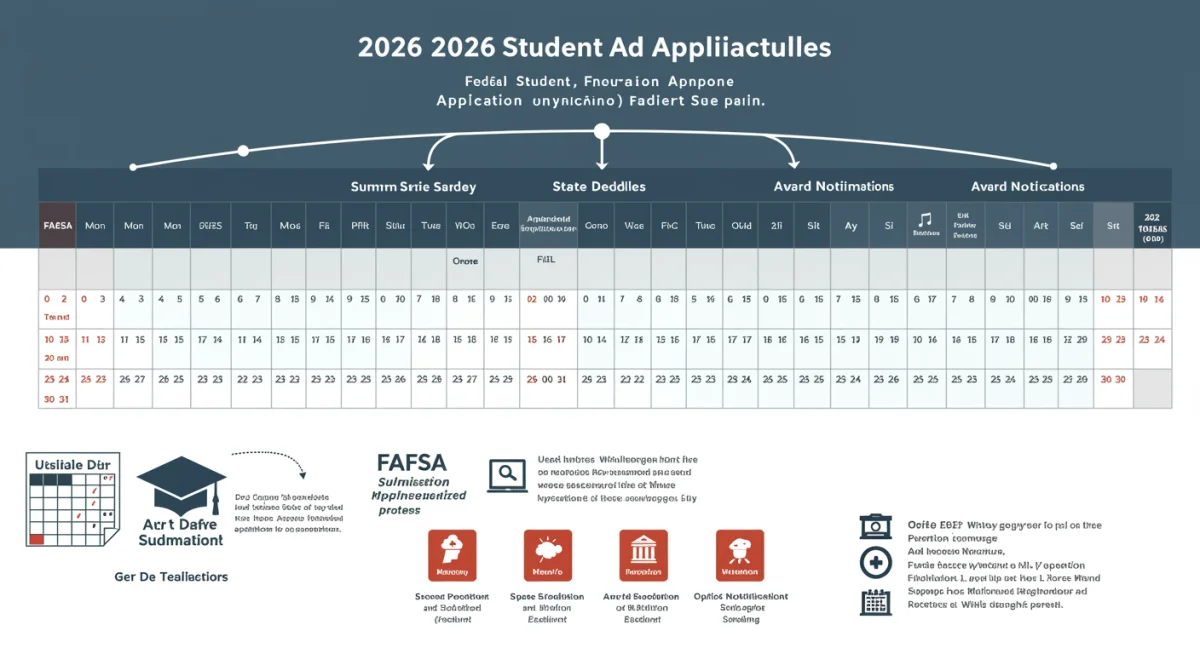
Key Deadlines to Remember:
- Federal Deadline: This is the absolute last day to submit your FAFSA. While this deadline is usually quite late in the academic year (typically June 30th of the academic year for which you are applying), it’s highly advisable not to wait this long.
- State Deadlines: Many states have their own deadlines for state-specific financial aid. These can be much earlier than the federal deadline, and often operate on a "first-come, first-served" basis for some programs. Check your state’s higher education agency website for specific dates.
- College Deadlines: Each college or university you apply to will have its own financial aid deadline. These deadlines are often tied to early admission, early action, or regular decision application dates. Submitting your FAFSA by the college’s priority deadline is crucial for maximizing your chances of receiving institutional aid and ensuring your application is reviewed promptly.
Pro Tip: Always aim to submit your FAFSA as soon as it opens. This is often referred to as the "priority deadline" for many institutions. Funds for some aid programs are limited, and applying early increases your likelihood of receiving the maximum amount of aid you qualify for. For Federal Student Aid 2026, early submission will be key.
Who Needs to Complete the Federal Student Aid 2026 Application?
If you are a prospective student planning to attend college or career school between July 1, 2026, and June 30, 2027, you will need to complete the Federal Student Aid 2026 application. This includes:
- High school seniors applying for their first year of college.
- Current college students seeking financial aid for their continuing education.
- Graduate students applying for federal aid.
- Students attending vocational or trade schools.
Even if you think your family’s income is too high, it’s always recommended to complete the FAFSA. Many forms of aid are not solely need-based, and eligibility can be broader than expected. Furthermore, completing the FAFSA is a prerequisite for federal student loans, regardless of income. Without a FAFSA on file, you cannot access federal student loans, which often offer better terms than private loans.
Gathering Your Documents for Federal Student Aid 2026
Preparation is key to a smooth FAFSA experience. Before you even sit down to fill out the Federal Student Aid 2026 form, gather all necessary documents. This will save you time and prevent errors. Here’s a checklist of what you’ll likely need:
For the Student (and Spouse, if applicable):
- Federal Student Aid ID (FSA ID): Both the student and one parent (if the student is dependent) will need an FSA ID to access and sign the FAFSA electronically. Create yours well in advance at studentaid.gov/fsa-id/create-account.
- Social Security Number (SSN): Your SSN is essential.
- Alien Registration Number: If you are not a U.S. citizen but are an eligible non-citizen.
- Federal Tax Information: For the 2026-2027 FAFSA, you will need your 2024 federal income tax returns (IRS Form 1040, 1040-SR, 1040-NR, or 1040-PR/SS). While the DDX will import this, it’s good to have it on hand for reference.
- Records of Untaxed Income: This includes child support received, interest income, and veterans’ non-education benefits.
- Records of Assets: This includes cash, savings and checking account balances, investments (e.g., stocks, bonds, mutual funds, 529 plans), and real estate (excluding the family home).
For Parents (if the student is dependent):
- Parent FSA ID: One parent will also need an FSA ID.
- Parent Social Security Numbers: For all parents whose information is required.
- Parent Federal Tax Information: For the 2026-2027 FAFSA, this will be your 2024 federal income tax returns. Again, the DDX will handle the transfer, but have them ready.
- Records of Parents’ Untaxed Income: Similar to the student’s, this includes child support received, interest income, and veterans’ non-education benefits.
- Records of Parents’ Assets: Cash, savings and checking account balances, investments, and real estate (excluding the family home). Remember the new rules for family farms and small businesses.
It’s important to note that the FAFSA will ask for tax information from two years prior to the academic year for which you are applying. So, for Federal Student Aid 2026-2027, you’ll use your 2024 tax information.
Step-by-Step Guide to Completing the Federal Student Aid 2026 FAFSA
Once you have all your documents ready and you’ve created your FSA ID, you’re ready to tackle the FAFSA. Here’s a simplified step-by-step guide:
Step 1: Create Your FSA ID
If you haven’t already, the student and at least one parent (for dependent students) must create an FSA ID. This is your electronic signature and allows you to access and submit the FAFSA. It can take up to three days for your FSA ID to become active, so do this well in advance.
Step 2: Access the FAFSA Form
Go to studentaid.gov and click on "Start a New FAFSA." You will log in with your FSA ID.
Step 3: Provide Personal Information
Fill in all required personal information for the student, including name, date of birth, SSN, and contact details. You’ll also indicate your dependency status. The FAFSA will guide you through questions to determine if you are a dependent or independent student. This determination is critical as it dictates whether you need to provide parental information.
Step 4: Enter School Information
List all the colleges or universities you are considering. You can add up to 20 schools at a time. Each school you list will receive your FAFSA information, allowing them to calculate your aid eligibility. It’s crucial to list every school you might attend, even if you haven’t been accepted yet.
Step 5: Provide Financial Information (IRS Direct Data Exchange)
This is where the new process shines. For federal tax filers, you and your parent(s) will be prompted to consent to the IRS Direct Data Exchange (DDX). This allows your 2024 tax information to be securely transferred directly from the IRS to your FAFSA. This step is mandatory for federal student aid eligibility, even if you didn’t file taxes (you’ll still consent to the DDX, and it will confirm no tax data). If you or your parents did not file taxes, you will manually enter income information, but still must provide consent.
Step 6: Report Assets
Carefully report all required assets for both the student and, if applicable, the parents. This includes cash, savings, checking accounts, and investments. Remember the updated rules regarding family farms and small businesses for Federal Student Aid 2026.
Step 7: Review and Submit
Before submitting, thoroughly review all your answers for accuracy. Even small errors can cause delays or reduce your aid eligibility. Once you’re confident everything is correct, electronically sign the FAFSA using your FSA ID (and your parent’s FSA ID if you are a dependent student) and submit it.
Step 8: Confirmation and Student Aid Report (SAR)
After submission, you’ll receive a confirmation email. Within a few days (sometimes longer during peak periods), you’ll receive your Student Aid Report (SAR). The SAR summarizes the information you provided on your FAFSA and will include your Student Aid Index (SAI). Review your SAR carefully for any errors. If you find mistakes, you can make corrections online.
Understanding Your Student Aid Index (SAI) for Federal Student Aid 2026
The SAI is a crucial number that schools use to determine how much financial aid you are eligible to receive. It’s calculated based on a formula established by law, considering your (and your family’s) income, assets, and household size. A lower SAI indicates a greater financial need. Remember, the SAI can be as low as -1500, signifying maximum need.
How is Your Aid Package Determined?
Once your SAI is calculated, schools will use it to determine your financial aid package. The basic formula is:
Cost of Attendance (COA) – Student Aid Index (SAI) = Financial Need
The Cost of Attendance (COA) is an estimate of what it will cost to attend a particular school for one academic year. It includes tuition and fees, room and board, books and supplies, transportation, and personal expenses. Each school sets its own COA.
Your financial aid package will then consist of various types of aid (grants, scholarships, work-study, loans) to help cover your financial need, up to the COA. For Federal Student Aid 2026, understanding this formula is fundamental to interpreting your aid offers.
Maximizing Your Federal Student Aid 2026 Eligibility
While the FAFSA Simplification Act aims to make aid more accessible, there are still strategies you can employ to potentially maximize your eligibility for Federal Student Aid 2026:
1. Apply Early
As repeatedly emphasized, submit your FAFSA as soon as it opens. This ensures you are considered for all available aid, especially limited institutional and state funds.
2. Be Accurate and Thorough
Double-check every answer. Errors can lead to delays or incorrect aid calculations. If anything seems unclear, seek clarification from your school’s financial aid office or the Federal Student Aid website.
3. Understand Dependency Status
The FAFSA determines if you are a dependent or independent student based on specific criteria (age, marital status, military service, etc.). If you are classified as dependent, parental information is required. If you believe there are unusual circumstances that prevent you from providing parental information, contact your school’s financial aid office to discuss a dependency override.
4. Manage Your Finances Strategically
While the FAFSA uses prior-prior year income, your current assets are reported. If possible, minimize cash savings and non-retirement investment balances in the months leading up to filing the FAFSA. Money in checking and savings accounts is considered an asset. However, don’t make rash financial decisions that could negatively impact your family’s financial stability.
5. Report Special Circumstances
If your family’s financial situation has changed significantly since the 2024 tax year (e.g., job loss, divorce, death of a parent, high medical expenses), contact the financial aid office at each school you’ve applied to. They have the discretion to make adjustments to your FAFSA based on "special circumstances" or "professional judgment." Be prepared to provide documentation to support your claim.
6. Explore Other Aid Sources
While the FAFSA is the primary gateway to federal aid, don’t stop there. Actively search for external scholarships from private organizations, local community groups, and your high school. These can significantly reduce your overall college costs and often do not impact your federal aid eligibility negatively.
7. Continuously Monitor Your StudentAid.gov Account
Regularly check your account on studentaid.gov for any updates, requests for additional information, or changes to your application status. This proactive approach ensures you stay on top of the process for Federal Student Aid 2026.

What Happens After You Submit the Federal Student Aid 2026 FAFSA?
Submitting your FAFSA is a major milestone, but it’s not the end of the process. Here’s what you can expect next:
Receiving Your Student Aid Report (SAR)
As mentioned, after your FAFSA is processed, you’ll receive a Student Aid Report (SAR). This document summarizes the data you submitted and provides your Student Aid Index (SAI). Review it thoroughly. If you need to make corrections, you can do so online using your FSA ID.
Reviewing Financial Aid Offers from Schools
Once schools receive your FAFSA data, their financial aid offices will begin packaging aid offers. These offers typically detail the types and amounts of federal, state, and institutional aid you are eligible for (grants, scholarships, work-study, and loans). Aid offers usually start rolling out in the spring, depending on the school’s timeline.
Comparing Aid Offers
If you’ve applied to multiple schools, you’ll receive different aid offers. It’s crucial to compare these offers carefully. Don’t just look at the total aid amount; differentiate between gift aid (grants, scholarships) and self-help aid (loans, work-study). Consider the net price (Cost of Attendance minus gift aid) to understand your true out-of-pocket expenses for each institution.
Accepting Your Aid
Each school will have a process for accepting or declining the aid offered. You typically won’t accept all aid components at once. For instance, you might accept all grants and scholarships but choose to accept only a portion of the federal loans offered, or none at all, if you can cover the remaining costs through other means. Be mindful of the deadlines for accepting aid.
Verification Process
Some FAFSAs are selected for a process called "verification." This means the school’s financial aid office will request additional documentation to confirm the information you reported on your FAFSA. This is a routine process and not an indication of wrongdoing. If selected, respond promptly to all requests for documents to avoid delays in your aid disbursement.
Common Pitfalls to Avoid with Federal Student Aid 2026
Even with the streamlined process, certain mistakes can jeopardize your financial aid eligibility. Be aware of these common pitfalls:
- Not Creating an FSA ID in Time: Both student and parent need an active FSA ID to sign the FAFSA. Don’t wait until the last minute.
- Missing Deadlines: Federal, state, and institutional deadlines are critical. Mark them on your calendar and submit early.
- Making Errors on the FAFSA: Even minor typos can cause processing delays. Review your application carefully before submission.
- Failing to Consent to the IRS Direct Data Exchange: This is a mandatory step for federal aid eligibility.
- Not Reporting Special Circumstances: If your financial situation has changed, communicate with financial aid offices.
- Assuming You Won’t Qualify: Many families mistakenly believe they won’t qualify for aid due to income. The only way to know for sure is to apply.
- Only Looking at the Sticker Price: Focus on the "net price" after grants and scholarships, not just the advertised tuition.
- Ignoring Parental Information if Dependent: If you are a dependent student, your parents’ financial information is required, regardless of whether they plan to contribute to your education.
Future Outlook for Federal Student Aid
The landscape of federal student aid is dynamic, with ongoing discussions and potential legislative changes. The FAFSA Simplification Act was a major step, and future iterations may bring further refinements. Staying informed through official channels like studentaid.gov and your prospective schools’ financial aid offices is always the best approach. The goal remains to make higher education more accessible and affordable for all students, and your proactive engagement with the Federal Student Aid 2026 process is a crucial part of that mission.
Conclusion
Navigating the Federal Student Aid 2026 application process can seem daunting, but with proper preparation and understanding of the key changes, it becomes a manageable and rewarding endeavor. The FAFSA is your essential tool for accessing federal grants, scholarships, work-study, and loans that can significantly reduce the cost of your education. Remember to create your FSA ID early, gather all necessary documents, submit your application well before deadlines, and meticulously review all information. By taking these steps, you put yourself in the best position to secure the financial assistance you need to achieve your academic and career goals. Don’t let the complexities deter you; empower yourself with knowledge and take control of your financial future in higher education.