The Future of Work: How Automation and AI are Reshaping the U.S. Job Market by 2026
The landscape of the American workforce is undergoing a seismic shift, driven by the relentless march of technological innovation. As we hurtle towards 2026, the twin forces of Artificial Intelligence (AI) and automation are not merely incremental changes; they are fundamental disruptors, redefining job roles, creating new industries, and challenging traditional notions of employment. This article delves deep into the anticipated transformations, offering insider knowledge, comparative analyses, and strategic insights into the evolving AI Job Market 2026.
For decades, science fiction has painted a vivid, often dystopian, picture of a future dominated by machines. While the reality is far more nuanced, the impact of AI and automation on the U.S. job market is undeniable and accelerating. Businesses are adopting these technologies at an unprecedented pace to enhance efficiency, reduce costs, and unlock new capabilities. This adoption, in turn, has profound implications for every sector, from manufacturing and logistics to healthcare and creative industries.
Anúncios
Understanding these shifts is not just an academic exercise; it’s a critical necessity for policymakers, educators, business leaders, and individual workers alike. Preparing for the AI Job Market 2026 means anticipating the skills that will be in demand, the jobs that will evolve or disappear, and the strategies required to thrive in a technologically advanced economy. Our goal here is to provide a comprehensive, data-driven perspective on what lies ahead, moving beyond the sensational headlines to offer actionable insights.
The Current Trajectory: A Snapshot of AI and Automation Adoption
Before peering into 2026, it’s crucial to understand the current state of AI and automation adoption in the U.S. economy. While the technology has been developing for years, its mainstream integration has truly taken off in the last half-decade. Industries are leveraging AI for tasks ranging from predictive analytics and customer service chatbots to robotic process automation (RPA) and advanced manufacturing. The COVID-19 pandemic, surprisingly, accelerated this adoption, as businesses sought ways to maintain operations with reduced human contact and increased efficiency.
Anúncios
A recent report by the World Economic Forum highlighted that by 2025, 85 million jobs may be displaced by a shift in the division of labor between humans and machines, while 97 million new roles may emerge that are more adapted to the new division of labor. This isn’t a simple zero-sum game; it’s a complex redistribution and redefinition of work. The U.S., being a technological leader, is at the forefront of this transformation. Companies like Amazon, Tesla, and Google are pioneering new applications, but the impact extends far beyond tech giants, permeating small and medium-sized businesses as well.
The immediate effects are visible in sectors like warehousing and logistics, where automated guided vehicles (AGVs) and robotic arms handle repetitive tasks. In customer service, AI-powered chatbots are increasingly the first point of contact. Healthcare is utilizing AI for diagnostics, drug discovery, and personalized treatment plans. Financial services are employing AI for fraud detection and algorithmic trading. These are not future possibilities; they are present realities shaping the current AI Job Market 2026 trajectory.
Key Sectors and Their Transformation by 2026
The impact of AI and automation will not be uniform across all sectors. Some industries are inherently more susceptible to automation, while others will see complementary growth in human roles. Here’s a breakdown of how key U.S. sectors are expected to fare:
Manufacturing and Logistics: The Automation Frontier
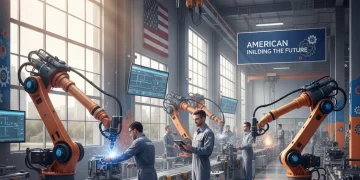
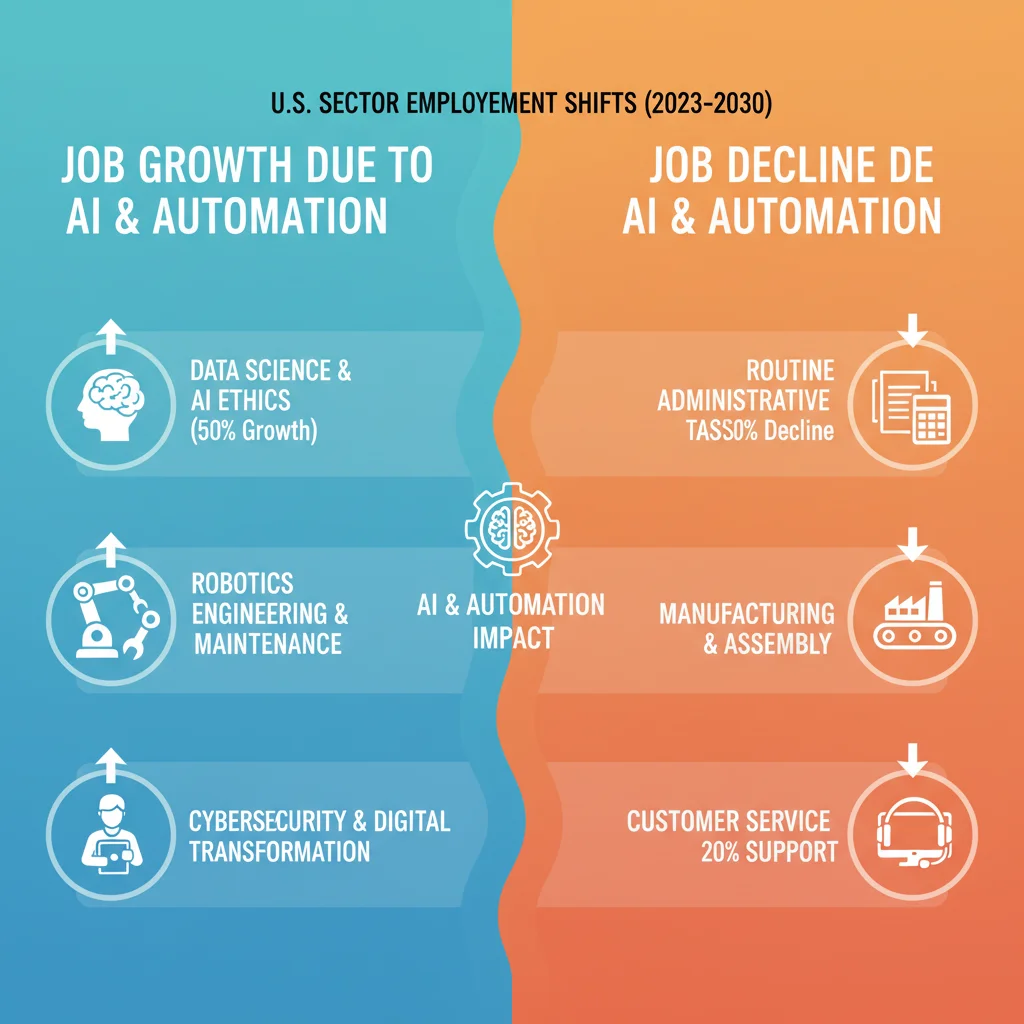
This sector has historically been the earliest adopter of automation, and by 2026, it will be even more profoundly transformed. Advanced robotics, AI-driven supply chain optimization, and automated quality control systems will become standard. While some manual labor roles will decline, there will be a surge in demand for robotics engineers, automation specialists, data analysts for supply chain management, and technicians capable of maintaining complex automated systems. The focus will shift from repetitive assembly to oversight, programming, and troubleshooting.
Healthcare: Aiding, Not Replacing
In healthcare, AI is primarily seen as an augmentation tool rather than a replacement. By 2026, AI will significantly enhance diagnostic capabilities (e.g., analyzing medical images with greater accuracy than humans), accelerate drug discovery, and personalize treatment plans. Robotic surgery will become more common, and administrative tasks will be streamlined by AI. This will create new roles for AI specialists in medical imaging, bioinformaticians, and data privacy experts. Doctors and nurses will spend less time on administrative burdens and more time on direct patient care, empathy, and complex problem-solving – skills that AI cannot replicate.
Retail and Customer Service: A Hybrid Approach
The retail sector will continue its evolution towards a hybrid model. E-commerce platforms will be heavily optimized by AI for personalized recommendations and inventory management. In physical stores, automation will handle tasks like inventory tracking and checkout. Customer service will see a greater reliance on AI chatbots for routine inquiries, freeing human agents to handle more complex or emotionally charged interactions. This means a demand for AI trainers, customer experience designers, and data privacy officers, alongside human customer service representatives with enhanced soft skills.
Finance and Accounting: Data-Driven Efficiency
AI’s ability to process vast amounts of data makes it invaluable in finance. By 2026, AI will be paramount in fraud detection, algorithmic trading, risk assessment, and personalized financial advice. Routine accounting tasks like data entry and reconciliation will be largely automated. This will lead to a shift in demand towards financial analysts with strong data science skills, cybersecurity specialists, and AI ethicists who can ensure fair and unbiased financial algorithms. The human element will focus on strategic advice, client relationships, and complex financial problem-solving.
Transportation: Autonomous Revolution
Autonomous vehicles, while still facing regulatory and ethical hurdles, will see significant advancements by 2026. Long-haul trucking, last-mile delivery, and even public transportation could integrate autonomous features. This will impact professional drivers, but simultaneously create massive demand for AI engineers, sensor specialists, cybersecurity experts for vehicle networks, and urban planners skilled in integrating autonomous systems into infrastructure. The AI Job Market 2026 in transportation will be defined by this autonomous revolution.
Emerging Job Roles and In-Demand Skills for the AI Job Market 2026
The narrative isn’t just about job displacement; it’s equally, if not more, about job creation and evolution. By 2026, several new roles will become prominent, and existing roles will require significantly different skill sets. Here’s a look at what to expect:
New Job Roles:
- AI Ethicists and Governance Specialists: Ensuring AI systems are fair, transparent, and accountable.
- Data Scientists and ML Engineers: Building, training, and deploying AI models.
- Robotics Engineers and Technicians: Designing, building, maintaining, and repairing robotic systems.
- Prompt Engineers: Optimizing inputs for generative AI models to produce desired outputs.
- Human-AI Interaction Designers: Creating intuitive and effective interfaces between humans and AI systems.
- Cybersecurity Analysts (AI-focused): Protecting AI systems from attacks and ensuring data integrity.
- Automation Architects: Designing and implementing automation solutions across enterprises.
- Digital Transformation Specialists: Guiding organizations through the adoption of new technologies.
In-Demand Skills:
Beyond specific job titles, a core set of skills will be crucial for navigating the AI Job Market 2026:
- Critical Thinking and Complex Problem-Solving: AI can process data, but humans excel at nuanced problem-solving.
- Creativity and Innovation: Generating new ideas and solutions, especially those requiring abstract thought.
- Emotional Intelligence and Interpersonal Skills: Empathy, collaboration, negotiation, and leadership become even more valuable.
- Digital Literacy and Data Fluency: Understanding how to work with data and digital tools.
- Adaptability and Lifelong Learning: The pace of technological change demands continuous skill development.
- AI Literacy: Not necessarily coding, but understanding AI’s capabilities, limitations, and ethical implications.
- Cross-Functional Collaboration: Working effectively with diverse teams, including human and AI components.
The Impact on Wages and Income Inequality
The widespread adoption of AI and automation also raises significant questions about wages and income inequality. As routine tasks become automated, jobs requiring higher-level cognitive skills, creativity, and emotional intelligence are likely to command higher wages. This could exacerbate the existing skills gap, leading to a widening disparity between high-skilled and low-skilled workers.
Studies by organizations like the National Bureau of Economic Research suggest that while automation can increase overall productivity and wealth, its benefits are not always evenly distributed. Workers whose tasks are easily automatable may face wage stagnation or reduction, while those in complementary roles (e.g., managing AI systems, developing new AI applications) will see their value increase. Addressing this challenge will require proactive policies, including investments in education, vocational training, and social safety nets.
The AI Job Market 2026 will likely see upward pressure on wages for highly specialized tech roles, while roles requiring less specialized skills might face downward pressure or require significant reskilling to remain competitive. This dynamic underscores the urgency for individuals and institutions to adapt.
Challenges and Opportunities for the U.S. Workforce
Navigating the transition to an AI-driven economy presents both formidable challenges and unprecedented opportunities.
Challenges:
- Job Displacement: While new jobs emerge, the transition period can be painful for displaced workers.
- Skills Gap: A mismatch between the skills workers possess and the skills employers need.
- Reskilling and Upskilling Infrastructure: The current educational and training systems may not be agile enough to meet the demand for new skills.
- Ethical and Societal Concerns: Bias in AI, data privacy, and the psychological impact of working alongside intelligent machines.
- Economic Inequality: The potential for a widening gap between those who benefit from AI and those who are left behind.
- Cybersecurity Risks: Increased reliance on AI systems creates new vulnerabilities.
Opportunities:
- Increased Productivity and Economic Growth: AI can unlock new levels of efficiency and innovation.
- Creation of New Industries and Job Roles: As seen with the internet, new technologies generate entirely new economic sectors.
- Enhanced Human Capabilities: AI can augment human intelligence, allowing us to focus on more complex, creative, and fulfilling work.
- Improved Quality of Life: AI applications in healthcare, transportation, and smart cities can lead to significant societal benefits.
- Personalized Education and Training: AI can tailor learning experiences to individual needs, accelerating skill development.
The strategic response to these challenges and opportunities will define the success of the U.S. in the AI Job Market 2026 and beyond.
Government, Education, and Industry: A Collaborative Approach
Successfully navigating the future of work requires a concerted effort from all stakeholders. No single entity can tackle the complexities of AI and automation alone.
Government’s Role:
Governments will need to play a pivotal role in shaping policies that support workforce adaptation. This includes:
- Investing in Education and Training: Funding for STEM education, vocational training programs, and lifelong learning initiatives focused on AI and digital skills.
- Developing Social Safety Nets: Exploring universal basic income (UBI) or enhanced unemployment benefits to support workers in transition.
- Regulating AI Ethically: Establishing frameworks for responsible AI development and deployment, addressing issues like bias, privacy, and accountability.
- Promoting Innovation: Creating incentives for businesses to invest in AI research and development while ensuring fair labor practices.
- Data Infrastructure: Investing in robust digital infrastructure to support a data-driven economy.
Education’s Role:
Educational institutions, from K-12 to universities and vocational schools, must rapidly adapt their curricula. This means:
- Emphasizing Foundational Skills: Strengthening critical thinking, problem-solving, and creativity.
- Integrating AI and Digital Literacy: Making basic understanding of AI, coding, and data science a core part of education.
- Promoting Lifelong Learning: Offering flexible, modular, and accessible training programs for adults.
- Fostering Interdisciplinary Learning: Breaking down traditional academic silos to prepare students for complex, hybrid roles.
- Partnerships with Industry: Collaborating with businesses to understand future skill demands and tailor programs accordingly.

Industry’s Role:
Businesses, as the primary adopters of AI, have a responsibility to invest in their workforce. This includes:
- Internal Reskilling and Upskilling Programs: Providing opportunities for current employees to acquire new skills.
- Ethical AI Deployment: Prioritizing responsible AI development, ensuring fairness and transparency.
- Human-Centered Automation: Designing AI systems that augment human capabilities rather than simply replacing them.
- Collaborating with Educational Institutions: Sharing insights on future skill needs and offering internships or apprenticeship programs.
- Fostering a Culture of Continuous Learning: Encouraging employees to embrace new technologies and adapt to change.
This collaborative ecosystem is vital for a smooth transition into the AI Job Market 2026.
Case Studies: Early Adopters and Their Lessons
To illustrate the practical implications of these trends, let’s consider a few hypothetical, yet representative, case studies:
Case Study 1: Automated Manufacturing Plant
A mid-sized automotive parts manufacturer in Ohio invested heavily in robotic automation and AI-driven predictive maintenance systems. Initially, 15% of assembly line jobs were eliminated. However, the company simultaneously invested in retraining 20% of its workforce for roles as robotics technicians, data analysts for production optimization, and AI system supervisors. The result was a 30% increase in productivity, a 10% reduction in waste, and the creation of a more highly skilled workforce. The key lesson: proactive investment in reskilling mitigated job displacement and boosted overall competitiveness.
Case Study 2: AI-Enhanced Customer Support Center
A large telecommunications company implemented an advanced AI chatbot to handle 70% of routine customer inquiries. This led to a restructuring of its human customer service team. Instead of reducing headcount, the company retrained agents to specialize in complex technical issues, provide personalized solutions, and manage customer relationships requiring high emotional intelligence. The AI handled the mundane, allowing humans to focus on high-value interactions, leading to higher customer satisfaction and improved employee morale. The AI Job Market 2026 in customer service will heavily favor these hybrid roles.
Case Study 3: Healthcare Diagnostics with AI
A major hospital system adopted AI for analyzing radiology scans, significantly improving the speed and accuracy of diagnoses for certain conditions. Radiologists, instead of being replaced, now work alongside the AI, reviewing its findings, focusing on ambiguous cases, and spending more time consulting with patients and referring physicians. This augmentation has freed up valuable time for medical professionals, allowing them to focus on complex interpretations and patient interaction, enhancing the overall quality of care.
The Human Element: Skills That AI Cannot Replicate
Amidst all the technological advancements, it’s crucial to remember the enduring value of human capabilities. While AI excels at processing data, identifying patterns, and performing repetitive tasks, there are inherent human qualities that remain irreplaceable, particularly within the context of the AI Job Market 2026.
- Empathy and Compassion: Essential in healthcare, social work, and customer relations, where understanding human emotion is paramount.
- Ethical Judgment: AI can follow rules, but it cannot intrinsically understand or apply complex ethical principles in novel situations.
- Creative Problem-Solving (Beyond Pattern Recognition): The ability to think abstractly, connect seemingly disparate ideas, and innovate truly new solutions.
- Strategic Thinking and Vision: Defining long-term goals, anticipating future trends, and making high-level strategic decisions.
- Interpersonal Communication and Influence: Building relationships, motivating teams, and negotiating complex agreements.
- Dexterity and Fine Motor Skills: While robotics is advancing, complex, adaptive manual dexterity in unstructured environments remains a human strength.
Therefore, the key for individuals is not to compete directly with AI but to cultivate and leverage these uniquely human attributes, positioning themselves in roles that complement AI’s strengths.
Preparing for the AI Job Market 2026: A Roadmap for Individuals
For individuals, proactive preparation is the cornerstone of success in the evolving job market. Here’s a roadmap:
- Assess Your Current Skills: Identify which of your skills are susceptible to automation and which are uniquely human.
- Embrace Lifelong Learning: Commit to continuous education. Online courses, certifications, and vocational training will be crucial.
- Develop AI Literacy: Understand the basics of AI, how it works, its applications, and its limitations. You don’t need to be a coder, but you need to be informed.
- Focus on Soft Skills: Cultivate critical thinking, creativity, emotional intelligence, communication, and adaptability. These are the skills AI struggles to replicate.
- Network Strategically: Connect with professionals in emerging fields and stay abreast of industry trends.
- Consider Hybrid Roles: Look for opportunities where human oversight and AI collaboration are key.
- Be Adaptable and Resilient: The job market will continue to evolve rapidly. A flexible mindset is essential.
The AI Job Market 2026 is not a static destination but a dynamic process of continuous adaptation. Those who embrace this reality will find themselves well-positioned for success.
Conclusion: A Future of Human-AI Collaboration
The year 2026 will mark a significant milestone in the integration of AI and automation into the U.S. job market. While concerns about job displacement are valid and must be addressed, the overarching trend points towards a future of human-AI collaboration. AI will increasingly handle the routine, data-intensive, and physically demanding tasks, freeing humans to focus on innovation, creativity, complex problem-solving, and interpersonal engagement.
The success of this transition hinges on a collective effort: governments establishing supportive policies, educational institutions adapting curricula, businesses investing in their workforces, and individuals committing to lifelong learning. The AI Job Market 2026 will demand new skills, foster new industries, and redefine what it means to work. By proactively understanding these changes and preparing for them, the U.S. workforce can not only weather the storm of technological disruption but also harness its immense potential to build a more productive, innovative, and ultimately, more human-centric economy.
The future of work is not a dystopian vision of machines taking over, but rather an exciting evolution where technology augments human potential, creating opportunities for growth, learning, and new forms of value creation. The journey to 2026 will be challenging, but with foresight and collaboration, it can lead to a more prosperous and fulfilling work landscape for all.