Energy Sector Trends 2026: Geopolitical Shifts & Renewable Investment Surge

Anúncios
Energy Sector Trends 2026: How Geopolitical Shifts are Driving a 10% Increase in Renewable Investments
The global energy landscape is in constant flux, a complex interplay of technological innovation, economic pressures, and, increasingly, geopolitical dynamics. As we look towards 2026, the confluence of these factors is poised to reshape the energy sector in profound ways, particularly in the realm of renewable energy investments. Insider knowledge and recent updates suggest a remarkable 10% increase in these crucial investments, a direct consequence of the turbulent geopolitical environment. This article delves deep into these transformative trends, providing a comprehensive analysis of the forces at play and what they mean for the future of energy.
Anúncios
The Geopolitical Imperative: Why Energy Security Demands Renewable Energy Investments
For decades, national energy strategies have been inextricably linked to geopolitical stability. Access to fossil fuels, particularly oil and natural gas, has often dictated foreign policy and international relations. However, recent global events have starkly highlighted the vulnerabilities inherent in this traditional model. Supply chain disruptions, price volatility, and the weaponization of energy resources have forced nations to re-evaluate their reliance on external energy sources. This re-evaluation is the primary catalyst for the burgeoning interest in renewable energy investments.
Geopolitical tensions, regional conflicts, and the ongoing push for energy independence are compelling governments and corporations alike to accelerate their transition to renewable energy. This isn’t merely an environmental mandate; it’s a strategic imperative. By investing in domestic solar, wind, hydro, and geothermal projects, countries can reduce their susceptibility to global energy market fluctuations and the political machinations of energy-exporting nations. The concept of ‘energy sovereignty’ is gaining unprecedented traction, making renewable energy investments a cornerstone of national security.
Furthermore, the race for technological dominance in renewable energy is itself becoming a geopolitical battleground. Nations understand that leadership in green technologies translates to economic power and influence on the global stage. This competition is spurring significant research and development, attracting further renewable energy investments and fostering rapid innovation. The shift is not just about replacing old energy sources; it’s about building a new, more resilient, and domestically controlled energy infrastructure.
Anúncios
Understanding the 10% Surge: Key Drivers of Renewable Energy Investments
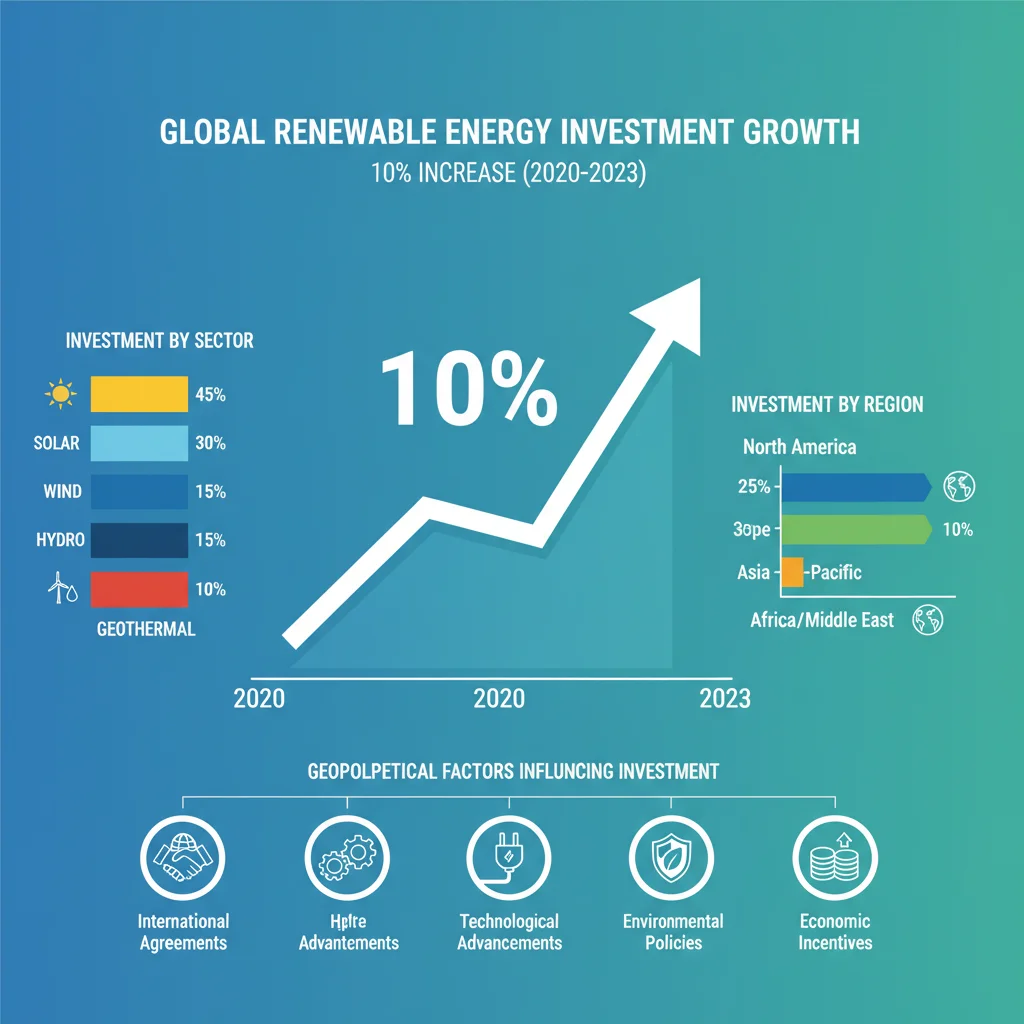
The projected 10% increase in renewable energy investments by 2026 is a significant indicator of a fundamental shift. Several key drivers underpin this surge:
- Government Policies and Incentives: Many governments worldwide are implementing aggressive policies to support renewable energy. These include tax credits, subsidies, feed-in tariffs, and carbon pricing mechanisms, all designed to make renewable energy investments more attractive than fossil fuel alternatives. The Inflation Reduction Act in the United States, for instance, is a prime example of legislation designed to supercharge green energy development.
- Technological Advancements and Cost Reductions: The cost of renewable energy technologies, particularly solar PV and wind power, has plummeted over the past decade. Efficiencies have increased, and manufacturing processes have become more streamlined. This makes renewable energy investments not just environmentally sound, but also economically competitive, often cheaper than new fossil fuel projects.
- Corporate Sustainability Goals (ESG): A growing number of corporations are committing to ambitious decarbonization targets, driven by investor pressure, consumer demand, and a recognition of climate risks. These Environmental, Social, and Governance (ESG) mandates necessitate substantial renewable energy investments to power their operations and supply chains with clean energy.
- Investor Confidence: As the renewable energy sector matures and demonstrates consistent returns, investor confidence is soaring. Institutional investors, private equity firms, and even individual investors are increasingly allocating capital to green energy projects, viewing them as stable, long-term investments with significant growth potential. The stability offered by long-term power purchase agreements (PPAs) further de-risks these ventures.
- Grid Modernization and Storage Solutions: The intermittent nature of some renewable energy sources has historically posed challenges. However, rapid advancements in battery storage technologies, smart grid solutions, and demand-side management are addressing these issues, making large-scale renewable energy investments more viable and reliable.
- Public Opinion and Climate Awareness: A heightened global awareness of climate change and its impacts is creating strong public support for renewable energy. This societal pressure translates into political will and consumer preference, further accelerating the transition and encouraging more renewable energy investments.
Regional Hotspots: Where Renewable Energy Investments are Flourishing
While the surge in renewable energy investments is a global phenomenon, certain regions are emerging as hotspots due to a unique combination of resources, policy frameworks, and market demand.
Asia-Pacific Leading the Charge
The Asia-Pacific region, particularly China and India, continues to dominate global renewable energy investments. China, already the world’s largest renewable energy producer, is investing massively in solar, wind, and hydropower to meet its colossal energy demands and address severe air pollution. India is also making significant strides, aiming for ambitious renewable energy targets to fuel its economic growth. Other nations in the region, such as Vietnam, South Korea, and Japan, are also ramping up their renewable energy investments, driven by energy security concerns and climate commitments.
Europe’s Ambitious Green Deal
Europe, spurred by its Green Deal and the recent energy crisis stemming from geopolitical events, is aggressively pursuing renewable energy investments. The continent is focused on diversifying its energy mix, phasing out fossil fuels, and becoming a global leader in green technologies. Offshore wind, in particular, is seeing unprecedented investment, alongside significant efforts in solar and hydrogen development. The EU’s commitment to reducing emissions by at least 55% by 2026 is a powerful driver for sustained renewable energy investments.
North America’s Resurgence
North America is experiencing a significant resurgence in renewable energy investments, largely thanks to supportive policies like the Inflation Reduction Act in the US and Canada’s clean energy initiatives. The US is seeing a boom in solar and wind project development, alongside increasing interest in geothermal and advanced nuclear technologies. Mexico is also exploring its vast renewable potential, albeit with a more variable policy landscape. This regional growth is crucial for achieving global decarbonization targets and fostering energy independence.
The Role of Geopolitical Shifts in Accelerating the Transition
It’s impossible to overstate the impact of geopolitical shifts on the acceleration of renewable energy investments. The traditional energy order, dominated by fossil fuel-producing nations, is being challenged from multiple directions. Recent conflicts and diplomatic tensions have exposed the fragility of global supply chains and the inherent risks of relying on a concentrated few for energy needs. This vulnerability has acted as a powerful accelerant for national strategies to bolster energy independence through domestic renewable sources.
For instance, the European energy crisis, largely a result of geopolitical tensions, directly led to a significant increase in the EU’s targets for renewable energy deployment and energy efficiency. This reactive policy shift has translated into billions of euros in new renewable energy investments across the continent. Similarly, nations in Asia and Africa, keenly aware of their energy security challenges, are increasingly turning to localized renewable solutions to power their development without being beholden to volatile international markets.
Moreover, the strategic competition between major global powers often includes a race for leadership in green technologies. This competition is not just about market share; it’s about setting global standards, controlling critical supply chains for renewable components, and ultimately, wielding influence in the emerging green economy. This geopolitical backdrop creates a powerful incentive for states to support and subsidize renewable energy investments, ensuring their domestic industries remain competitive and innovative.
Challenges and Opportunities for Renewable Energy Investments
While the outlook for renewable energy investments is overwhelmingly positive, challenges remain. Grid infrastructure needs significant upgrades to handle the influx of intermittent renewable energy. Permitting processes can be slow and cumbersome. Supply chain vulnerabilities, particularly for critical minerals and rare earths, still exist and require strategic attention. Furthermore, the integration of diverse renewable sources into a cohesive, reliable energy system demands sophisticated technological solutions and policy coordination.
However, these challenges also present immense opportunities. The need for grid modernization is driving innovation in smart grid technologies, energy storage, and AI-driven energy management systems. The demand for critical minerals is spurring new exploration, recycling initiatives, and the development of alternative materials. The complexity of integrating renewables is fostering cross-sector collaboration and the creation of entirely new industries, further boosting renewable energy investments and job creation.
The opportunity for developing nations is particularly significant. Renewable energy offers a pathway to leapfrog traditional fossil fuel-based development, providing clean, decentralized energy access to populations that have historically lacked it. This not only addresses energy poverty but also contributes to global climate goals and fosters sustainable economic growth, attracting considerable renewable energy investments from international development banks and private entities.
The Long-Term Impact: Beyond 2026
The 10% increase in renewable energy investments by 2026 is not an isolated event but a critical milestone in a much larger, long-term energy transition. This acceleration will have ripple effects across various sectors. For instance, the transportation sector will see faster adoption of electric vehicles, supported by a cleaner grid. Industrial processes will increasingly shift towards green hydrogen and other renewable-powered solutions. The built environment will become more energy-efficient, leveraging smart technologies and distributed renewable generation.
The economic benefits are also substantial. Renewable energy investments create jobs in manufacturing, installation, operation, and maintenance. They stimulate local economies and reduce reliance on imported fuels, strengthening national balance sheets. Moreover, the health benefits of reduced air pollution, a direct consequence of transitioning away from fossil fuels, will lead to significant cost savings in healthcare and improved quality of life.
From an environmental perspective, sustained and growing renewable energy investments are absolutely essential to meet global climate targets and mitigate the most severe impacts of climate change. Each percentage point increase in renewable energy deployment brings us closer to a sustainable future, demonstrating that economic growth and environmental stewardship are not mutually exclusive but deeply interconnected.
Insider Knowledge: Emerging Trends and Strategic Considerations for Renewable Energy Investments
Beyond the headline figures, several nuanced trends and strategic considerations are shaping the future of renewable energy investments. Understanding these provides a deeper insight into where the market is heading and where the next wave of opportunities will emerge.
Hybrid Projects and Energy Storage Integration
The future of renewable energy is increasingly hybrid. Combining solar and wind power, often co-located with battery storage, is becoming a preferred model. These hybrid projects offer greater reliability, reduce intermittency, and optimize grid connections, making them highly attractive for renewable energy investments. The ability to store excess energy for deployment during peak demand or when generation is low significantly enhances the value proposition of renewables.
Green Hydrogen’s Ascendance
Green hydrogen, produced by electrolyzing water using renewable electricity, is rapidly gaining traction as a key decarbonization pathway for hard-to-abate sectors like heavy industry, long-haul transport, and aviation. While still in its nascent stages, massive renewable energy investments are flowing into green hydrogen production, infrastructure, and end-use applications. The geopolitical desire for energy independence is also fueling interest in hydrogen as a versatile energy carrier, reducing reliance on traditional fossil fuel imports.
Decentralized Energy Systems and Microgrids
Geopolitical instability also highlights the resilience offered by decentralized energy systems and microgrids. These systems, often powered by local renewables and storage, can operate independently of the main grid, providing critical power during outages or emergencies. Renewable energy investments in microgrids are increasing, particularly in remote areas, islands, and critical infrastructure facilities, offering enhanced energy security and resilience.
Circular Economy Principles in Renewable Manufacturing
As the volume of renewable energy infrastructure grows, so does the focus on sustainability throughout its lifecycle. This includes adopting circular economy principles in manufacturing, aiming to reduce waste, recycle materials, and minimize the environmental footprint of solar panels, wind turbines, and batteries. This commitment to sustainability across the value chain will influence future renewable energy investments, favoring companies with strong ESG credentials and innovative recycling solutions.
Digitalization and AI in Energy Management
The effective integration and management of a complex, distributed renewable energy system relies heavily on digitalization and artificial intelligence. AI-powered forecasting, grid optimization, predictive maintenance, and energy trading platforms are becoming indispensable. Renewable energy investments are increasingly directed towards these digital solutions, enhancing efficiency, reliability, and profitability across the entire energy value chain.
Conclusion: A New Era of Renewable Energy Investments
The year 2026 is set to mark a pivotal moment in the global energy transition, characterized by an unprecedented surge in renewable energy investments. This 10% increase is not merely a statistical anomaly but a clear signal of a fundamental, irreversible shift driven by complex geopolitical forces, technological breakthroughs, and a growing recognition of climate urgency. Nations and corporations are realizing that energy security, economic stability, and environmental sustainability are deeply intertwined, with renewable energy at their core.
The path ahead will undoubtedly present challenges, but the opportunities unleashed by this wave of renewable energy investments are far greater. From new technologies and innovative business models to job creation and enhanced energy independence, the future of energy is being redefined. As geopolitical landscapes continue to evolve, the strategic importance of domestic, clean energy sources will only intensify, solidifying the role of renewable energy as the bedrock of global energy policy for decades to come.
Embracing these trends is not just an option; it’s a necessity for those seeking to thrive in the new energy paradigm. The insights and updates discussed here underscore a future where renewable energy is not just an alternative, but the primary engine of progress and stability.