Student Loan Repayment Strategies for 2026: A Comprehensive Guide to Income-Driven Plans and Accelerated Payoff Methods
The landscape of student loan repayment is constantly evolving, and for those grappling with educational debt, understanding the most effective student loan repayment strategies is paramount. As we look towards 2026, borrowers face a critical juncture: how best to manage their loans to minimize financial burden and achieve long-term financial stability. This comprehensive guide will delve into the nuances of various repayment options, specifically comparing income-driven repayment (IDR) plans with accelerated payoff methods, to help you make an informed decision tailored to your unique financial situation.
Student loans represent a significant financial commitment for millions. The average student loan debt continues to climb, making strategic repayment more crucial than ever. Whether you’re a recent graduate or have been navigating repayment for years, the choices you make today will profoundly impact your financial future. This article aims to demystify the options, highlight their pros and cons, and provide actionable insights into choosing the best student loan repayment strategies for you.
Anúncios
Understanding the Current Student Loan Landscape for 2026
Before diving into specific strategies, it’s essential to grasp the current environment surrounding student loans. Policy changes, economic shifts, and interest rate fluctuations can all influence the optimal approach to repayment. For 2026, borrowers should be aware of potential updates to federal programs, particularly regarding the ongoing adjustments to income-driven repayment plans and the broader economic outlook that might affect interest rates and job markets.
The federal government periodically introduces or modifies student loan programs to address the evolving needs of borrowers. Staying informed about these changes is a critical first step in formulating effective student loan repayment strategies. For instance, the new SAVE Plan (Saving on a Valuable Education), which replaced the REPAYE plan, offers significant benefits for many borrowers, including lower monthly payments and a more generous interest subsidy. Understanding such updates is key to optimizing your repayment plan.
Anúncios
Beyond federal policy, personal financial circumstances play a huge role. Your income, family size, career trajectory, and other debts all contribute to what constitutes the ‘best’ strategy for you. There’s no one-size-fits-all solution, making a personalized approach to student loan repayment strategies indispensable.
Income-Driven Repayment (IDR) Plans: A Detailed Overview
Income-Driven Repayment (IDR) plans are designed to make student loan payments more affordable by capping them at a percentage of your discretionary income. These plans are particularly beneficial for borrowers with high debt relative to their income, or those experiencing financial hardship. For federal student loans, there are several IDR plans, each with slightly different terms and eligibility requirements.
The SAVE Plan (Saving on a Valuable Education)
The SAVE Plan, which fully rolled out in 2024, is one of the most impactful developments in federal student loan repayment. It offers the lowest monthly payments of any IDR plan for many borrowers, especially those with undergraduate loans. Under SAVE, payments for undergraduate loans are calculated at 5% of discretionary income, down from 10% on most other IDR plans. For graduate loans, it remains 10%, and a weighted average is used for those with both. A significant feature is the interest subsidy: if your calculated payment doesn’t cover the monthly interest, the government covers the unpaid portion, preventing your loan balance from growing due to accruing interest.
Eligibility for the SAVE Plan is broad, open to most federal loan borrowers, including Direct Subsidized, Unsubsidized, PLUS loans (for students), and consolidated loans that include these types. Payments are recalculated annually based on updated income and family size. After 20 or 25 years of qualifying payments (depending on the loan type and amount), any remaining balance is forgiven, though this forgiven amount may be taxable income.
Other Key IDR Plans: PAYE, IBR, and ICR
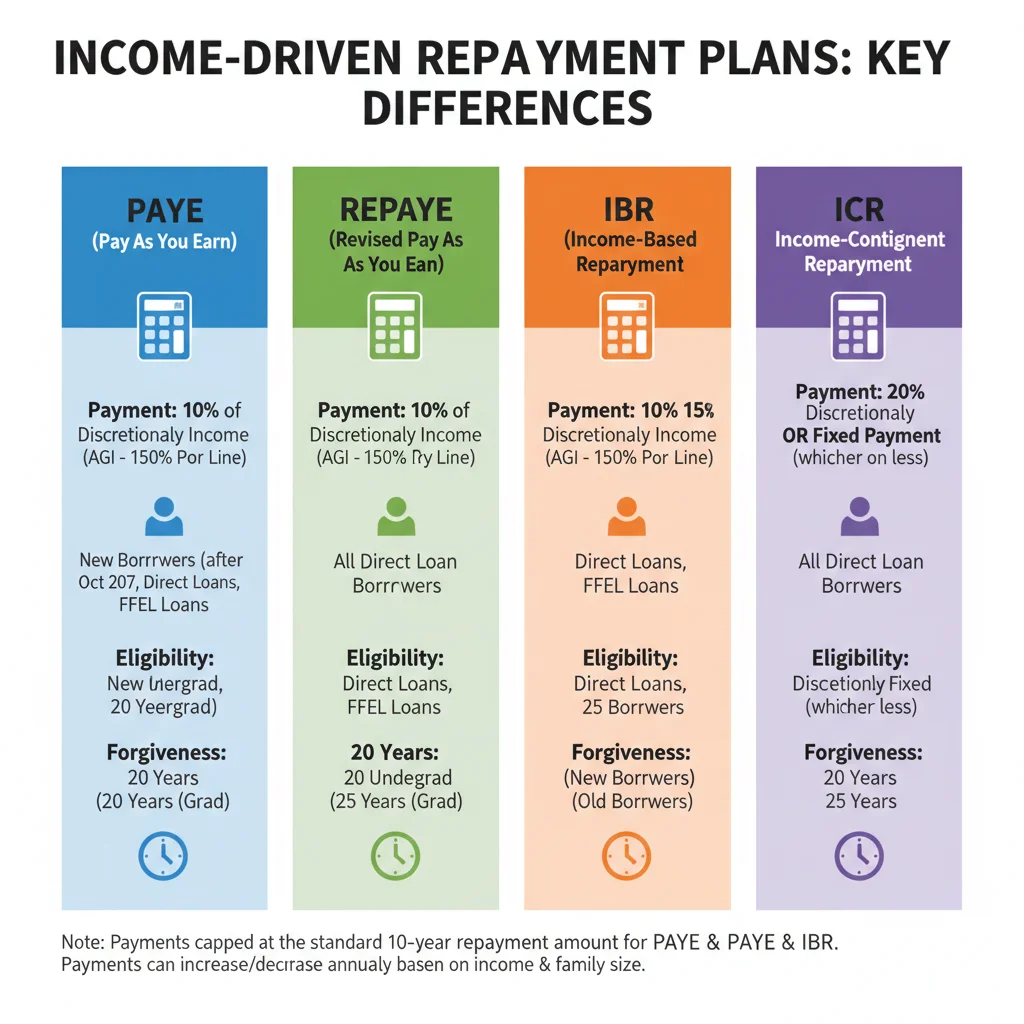
- Pay As You Earn (PAYE): Payments are generally 10% of your discretionary income, but never more than what you would pay on the 10-year Standard Repayment Plan. Forgiveness after 20 years. Eligibility requires you to be a new borrower on or after October 1, 2007, and have received a disbursement of a Direct Loan on or after October 1, 2011.
- Income-Based Repayment (IBR): Payments are either 10% or 15% of your discretionary income, depending on when you took out your loans, and are capped at the 10-year Standard Repayment Plan amount. Forgiveness after 20 or 25 years.
- Income-Contingent Repayment (ICR): Payments are either 20% of your discretionary income or what you would pay on a fixed 12-year repayment plan, adjusted by income, whichever is less. Forgiveness after 25 years. This is the only IDR plan available for Parent PLUS loans (after consolidation).
Choosing among these IDR plans requires careful consideration of your loan types, income, family size, and long-term financial goals. Each plan has different definitions of discretionary income, payment caps, and forgiveness timelines. A detailed comparison is often necessary to identify the most advantageous option for your student loan repayment strategies.
Pros and Cons of IDR Plans
Pros:
- Affordable Payments: Payments are tied to your income, making them manageable even during periods of low earnings.
- Interest Subsidy: Some plans, like SAVE, offer interest subsidies to prevent loan balances from growing.
- Loan Forgiveness: After a specified period (20 or 25 years), any remaining balance is forgiven.
- Protection Against Default: Lower payments reduce the risk of falling behind and defaulting on your loans.
Cons:
- Longer Repayment Period: Payments are often lower than the Standard Plan, meaning you’ll be in repayment for a longer time.
- More Interest Paid Over Time: While monthly payments are lower, you might pay more in total interest over the life of the loan.
- Tax Bomb on Forgiveness: The forgiven amount at the end of the repayment period may be considered taxable income by the IRS, leading to a potentially large tax bill. (Note: This is currently waived for federal loans through 2025, but may return).
- Annual Recertification: You must submit income and family size information annually, which can be cumbersome.
For many, particularly those in public service careers, IDR plans combined with Public Service Loan Forgiveness (PSLF) can be powerful student loan repayment strategies. PSLF offers tax-free forgiveness after 10 years of qualifying payments while working for an eligible government or non-profit organization. This can be a game-changer for those committed to public service.
Accelerated Payoff Methods: Paying Down Debt Faster
In contrast to IDR plans, accelerated payoff methods focus on reducing your loan balance as quickly as possible, thereby minimizing the total interest paid over the life of the loan. These strategies are generally more suitable for borrowers with higher incomes relative to their debt, or those who prioritize becoming debt-free sooner.
The Snowball and Avalanche Methods
- Debt Snowball Method: With this approach, you pay the minimum on all your loans except the one with the smallest balance, which you attack with extra payments. Once that loan is paid off, you take the money you were paying on it and add it to the payment of the next smallest loan. This creates a ‘snowball’ effect, building momentum and psychological wins as you eliminate debts. While it might not save the most interest, the psychological boost can be incredibly motivating for some in their student loan repayment strategies.
- Debt Avalanche Method: This method focuses on paying off the loan with the highest interest rate first, while making minimum payments on all other loans. Once the highest-interest loan is gone, you move on to the next highest. This strategy saves you the most money in interest over time and is mathematically the most efficient way to pay off debt.
Refinancing Student Loans
Refinancing involves taking out a new private loan to pay off existing federal or private student loans. The goal is typically to secure a lower interest rate, a shorter repayment term, or a lower monthly payment (though the latter often means a longer term and more interest). Refinancing can be a powerful tool for accelerated payoff if you can qualify for a significantly lower interest rate.
Pros of Refinancing:
- Lower Interest Rate: Can save you thousands of dollars in interest over the life of the loan.
- Simplified Payments: Consolidates multiple loans into one, with a single monthly payment.
- Shorter Repayment Term: Option to choose a shorter term, leading to faster debt freedom.
Cons of Refinancing:
- Loss of Federal Benefits: Refinancing federal loans into a private loan means forfeiting federal protections like IDR plans, deferment, forbearance, and potential forgiveness programs (e.g., PSLF). This is a critical consideration when evaluating student loan repayment strategies.
- Credit Score Dependent: Eligibility and interest rates are heavily dependent on your credit score and income.
- No Payment Pause Options: Private loans typically offer fewer options for pausing payments during financial hardship.
Making Extra Payments and Bi-Weekly Payments
Even without refinancing or strict snowball/avalanche methods, simply making extra payments can significantly accelerate your payoff. Even small additional amounts can shave years off your repayment term and save substantial interest. Another effective tactic is making bi-weekly payments. Instead of 12 monthly payments, you make 26 half-payments per year, which effectively adds one extra full payment each year, reducing your principal faster.

Pros and Cons of Accelerated Payoff Methods
Pros:
- Significant Interest Savings: Paying off loans faster drastically reduces the total interest paid.
- Faster Debt Freedom: You become debt-free sooner, freeing up cash flow for other financial goals.
- Psychological Boost: The feeling of eliminating debt can be incredibly motivating and reduce stress.
Cons:
- Higher Monthly Payments: Requires committing more money each month than minimum payments or IDR plans.
- Less Financial Flexibility: Directing more funds to loans might limit your ability to save for other goals or handle emergencies.
- Loss of Federal Protections (if refinancing): As mentioned, refinancing federal loans sacrifices valuable benefits.
Comparing IDR Plans and Accelerated Payoff for 2026
The decision between IDR plans and accelerated payoff methods hinges on your personal financial situation, career path, and risk tolerance. There isn’t a universally ‘better’ option; rather, it’s about finding the strategy that best aligns with your circumstances for your student loan repayment strategies.
When to Consider IDR Plans:
- High Debt-to-Income Ratio: If your student loan balance is large compared to your income, IDR plans can make payments manageable.
- Unstable Income: If your income fluctuates or you anticipate periods of lower earnings, IDR plans offer flexibility.
- Pursuing Public Service: If you work for a qualifying non-profit or government agency, IDR plans are essential for PSLF eligibility.
- Prioritizing Other Financial Goals: If you need to prioritize saving for a down payment, retirement, or other immediate needs, lower IDR payments can free up cash flow.
- Large Loan Balance and Lower Earning Potential: If your degree hasn’t led to a high-paying job, IDR plans can provide a safety net and eventual forgiveness.
When to Consider Accelerated Payoff:
- Stable and Higher Income: If you have a steady, comfortable income that allows for extra payments without undue hardship.
- Low Interest Rates (especially after refinancing): If you can secure a significantly lower interest rate through refinancing, accelerating payoff becomes even more cost-effective.
- Debt-Free Lifestyle Priority: If your primary goal is to eliminate debt as quickly as possible and reduce total interest paid.
- Minimal Other High-Interest Debt: If student loans are your primary debt and you have a solid emergency fund.
- Comfort with Financial Risk: You’re willing to give up federal protections for potential interest savings (if refinancing).
Hybrid Approaches and Strategic Planning
It’s important to remember that student loan repayment strategies are not always mutually exclusive. Sometimes, a hybrid approach can be the most effective. For example, you might start on an IDR plan while your income is lower, and then switch to an accelerated payoff method once your income increases and you’ve built a solid financial foundation. Or, you might use an IDR plan to keep payments low while aggressively saving for a down payment, then once that goal is achieved, redirect funds to accelerate loan repayment.
Key Steps for Strategic Repayment in 2026:
- Assess Your Current Situation: Gather all your loan information (balances, interest rates, loan types – federal vs. private). Analyze your income, expenses, and overall financial goals.
- Understand Federal Loan Options: Familiarize yourself with all federal repayment plans, especially the SAVE Plan and PSLF eligibility if applicable. Use the Federal Student Aid website’s Loan Simulator tool.
- Evaluate Refinancing: If you have good credit and stable income, get quotes from private lenders to see what interest rates you could qualify for. Weigh the pros and cons of losing federal protections carefully.
- Create a Budget: A detailed budget is crucial for any repayment strategy. It helps you identify areas where you can cut expenses and free up money for extra payments or savings.
- Build an Emergency Fund: Before aggressively paying down debt, ensure you have an emergency fund (3-6 months of living expenses) to prevent financial setbacks from derailing your plan.
- Consider Your Long-Term Goals: Do you want to buy a house, start a family, or retire early? Your loan repayment strategy should align with these broader life goals.
- Seek Professional Advice: If you’re overwhelmed, consider consulting with a non-profit credit counselor or a fee-only financial advisor who specializes in student loan debt.
- Stay Informed: Continue to monitor federal student loan policy changes, as these can significantly impact your best repayment options.
The Role of Financial Literacy in Student Loan Management
Ultimately, successful student loan management boils down to robust financial literacy. Understanding compound interest, budgeting, saving, and investing are all interconnected components that empower you to make the best decisions for your debt. Many borrowers find themselves in a reactive state, merely making minimum payments. However, proactive engagement with your finances, particularly your student loans, can transform a daunting burden into a manageable challenge.
Educating yourself on the nuances of different repayment plans, understanding how interest accrues, and recognizing the long-term implications of your choices are vital. Tools like loan calculators, financial planning apps, and educational resources from reputable financial institutions can be invaluable assets in this journey. The more informed you are, the better equipped you’ll be to adapt your student loan repayment strategies as your life and financial circumstances evolve.
Conclusion: Crafting Your Optimal Student Loan Repayment Strategy
Choosing the right student loan repayment strategies for 2026 is a highly personal decision that requires careful evaluation of your financial situation, career aspirations, and risk tolerance. Whether you opt for the safety net and potential forgiveness of an Income-Driven Repayment plan or the aggressive interest savings of an accelerated payoff method, the key is to be proactive and informed.
Regularly review your loans, stay updated on policy changes, and don’t hesitate to adjust your strategy as your life circumstances change. By taking a thoughtful and strategic approach, you can navigate the complexities of student loan debt, minimize its impact on your financial life, and move closer to achieving your financial goals. Remember, the best strategy is the one that works for you, providing both financial relief and a clear path to debt freedom.